 Vittelio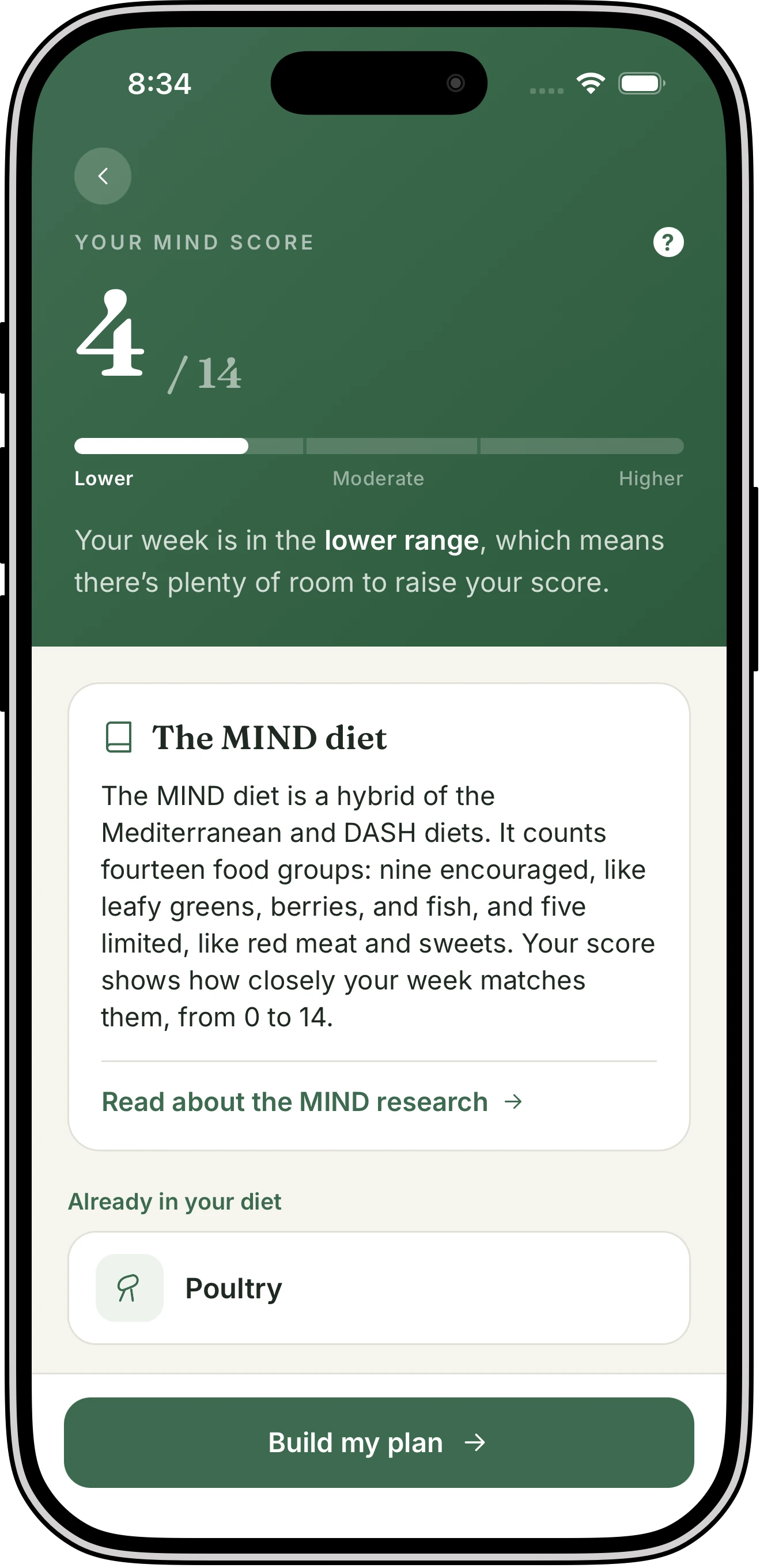
What the number means
The MIND diet counts fourteen food groups: nine encouraged, like leafy greens, berries, and fish, and five limited, like red meat and sweets. Your score shows how closely your week matches them. Each group earns 0, 0.5, or 1 point against a weekly cutoff, and the points add up to a total out of 14.
Because every group is scored on weekly frequency, the score describes your pattern, not your plate: eating salmon once doesn't make a fish point, and one burger doesn't erase your vegetables. The app shows the total on a simple band — Lower, Moderate, or Higher adherence — so the number always comes with its meaning.
Scored like the research
Vittelio follows the scoring method from the study that introduced the MIND diet (Morris et al., 2015 ↗): the same food groups and the same weekly cutoffs, applied to the week you reported. The original score also included wine as a fifteenth component; Vittelio deliberately leaves it out, so the maximum is 14. There are no proprietary points, no multipliers, and nothing gamified about the number.
You can read the studies behind the diet — including the randomized trial — in our plain-language guide to the MIND diet, which is also available inside the app with citations to every source.
Honest by design
The score is a measurement, not a reward system. It moves in honest half-point steps, it can go down as well as up, and logging a limit food can never raise it. When you later accept a few swaps and cook them, the score climbs because the week genuinely matches the pattern better — not because the app is being encouraging.